

Top 4 Easy Gin Cocktails to Make at Home
by Andrew Tardif
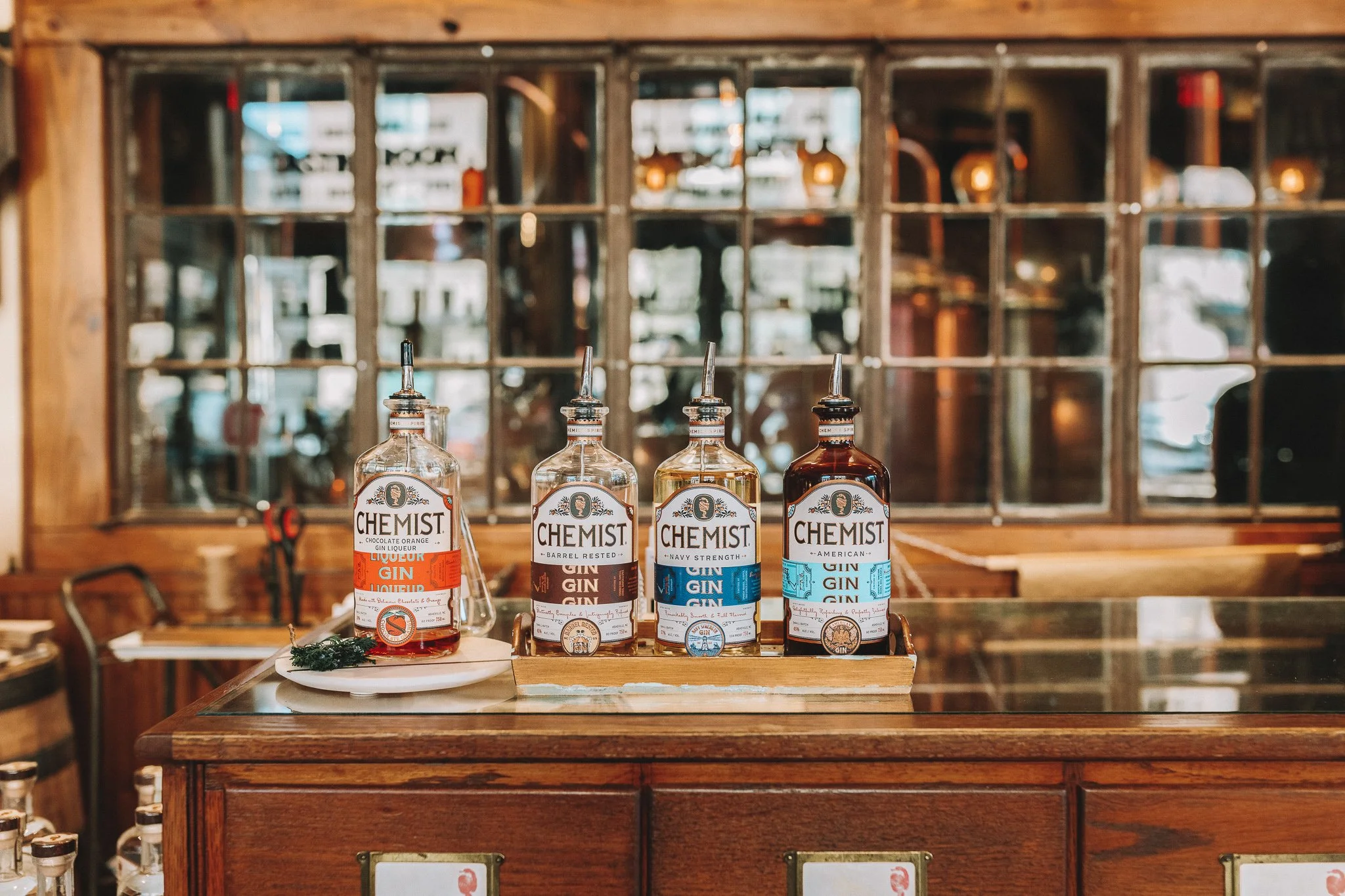
Mixology can be a daunting task, luckily you have some Chemists here who have done the necessary experimentation to bring you 4 easy gin cocktails you can make at home. These cocktails are simple and have survived for at least a century, holding up as some of the most popular gin cocktails.
And remember, these recipes are guides, never rules. At your laboratory you’re the chemist, so you can adjust the ratios to your liking. Just because that’s the way they made it in 1919, or something, doesn’t mean that’s the way you have to make it to enjoy it!
What Barware You’ll Need to Make Your Own Gin Drinks
To us, easy gin cocktails use ingredients that are easy to get, but are more involved than something like a Gin Rickey or Gin and Tonic. That means they will require some tools. Here’s what you need to make these easy gin cocktails at home:
Shaker Tin
Jigger
Strainer
Mixing Glass
Stirring Spoon
Ice
Glassware: Coupe, Rocks Glass, Collins Glass, and/or Champagne Flute
What Type of Gin To Use
The type of gin you use is dependent on your own personal tastes, but can be defined by the specific cocktail. For instance, dry gin is very common in a Martini, but if you prefer something sweeter, an Old Tom Gin will be better suited for you, while a Plymouth Gin will give an earthier more rounded Martini.
For the more spirit-forward Negroni, we recommend experimenting with a barrel-rested gin, which can impart more depth to the cocktail. If not, a more potent, spicy, and citrus forward gin like our Navy Strength can keep up with the bitterness of the Campari.
For a gin cocktail with lemon or other citrus, like the Gimlet and French 75, you may want a drier gin to stand out against the sweetness from the simple syrup and the bitterness from the citrus. More floral and citrusy New World Gins can really meld well with the citrus as well.
The Gin Martini and Some Variations
Made popular by Ian Fleming’s James Bond series, the Martini has been a favorite gin cocktail for gin drinkers because the spirit is the main star. The word “martini” can also serve as a blanket term for a sea of different cocktails, but we’ll just be discussing a standard martini, while mentioning some common variations.
The History of the Gin Martini
The history of the Martini, like many cocktails, is a little murky, but it seems to have evolved from the Martinez cocktail, which evolved from the Manhattan. While a Manhattan is Whisky (Rye), Sweet Vermouth, and Bitters, the Martinez swapped out the Whiskey for Gin and added in some Maraschino Liqueur.
The Martini we know today is closer to a Marguerite cocktail, which uses equal parts Gin (Plymouth, to be exact), French Vermouth (Dry), orange bitters, and anisette, but it seems many of these variations were existing around the same time with the first iterations emerging in the 1880s and 1890s.
The original written recipe for the Martini can be first found in the Bartender Manual by Harry Johnson and included gum syrup, a sweet syrup made of gum arabic, curacao, bitters, Old Tom Gin, sweet vermouth, and a lemon peel garnish.
Over time the Martini switched out the sweet vermouth for dry, and got rid of other ingredients like the bitters and anisette. The equal parts gin and vermouth changed to two parts gin and one part vermouth, and then continued to lessen the vermouth ratio until it was up to nine parts gin to one part vermouth.
At this moment in time, the ratios for the Martini are as varied as the people that drink them. When people order a Dirty Martini it’s always important to qualify just how “dirty” someone likes it. When people order a Dry Martini you have to know how dry they want it. Some folks want a Martini with no vermouth at all, known as an Extra Dry Martini.
There are many intricacies to the history of the drink, too much to properly put into a blurb, but one final thing to note is its popularity thanks to Ian Fleming’s James Bond novel, Casino Royal, which includes a recipe for a Vesper Martini. The recipe calls for three parts Gordon’s Gin to one part vodka and and half of Kina Lillet shaken, strained, and garnished with a lemon peel.
The Recipe

A Gin Martini*:
2 ½ oz Chemist American Gin
¾ oz Dry Vermouth
Place ingredients in a mixing glass.
Fill the mixing glass with ice.
Stir for at least 30 seconds
Strain into a chilled coupe or Nick and Nora
Garnish with a lemon peel, olive, or both. Whatever it is, the way you tell your story online can make all the difference.

The Vesper Martini*:
1 ½ oz Chemist American Gin
1 oz Chemist Vodka
½ oz Lillet Blanc or Cocchi Americano
Lemon Peel for garnish
Place ingredients in a mixing glass.
Fill the mixing glass with ice.
Stir for at least 30 seconds
Strain into a chilled coupe or Nick and Nora
Express lemon oil and garnish with a lemon peel
A Dirty Martini*:
2 ½ oz Chemist American Gin
¾ oz Olive Brine
Barspoon Dry Vermouth
Olive(s) for garnish
Place ingredients in a shaker tin
Shake with ice for 10 - 15 seconds
Strain into a chilled coupe or Nick and Nora
Garnish with an olive.
*These recipes are always starting points. Feel free to adjust ratios according to your own palette.
Negroni - A Popular Italian Gin Cocktail
This cocktail has regained popularity since the cocktail renaissance at the turn of the millenium, and many distilleries and cocktail bars celebrate Negroni week in September with their own renditions of the cocktail, but the basic Negroni is simple and can easily be batched for big parties.
The History
Although the origins of the cocktail are disputed, the main story has the Negroni being made in Italy as an evolution of a Milano-Torino, also called an Americano, a cocktail made of Italian Sweet Vermouth (from Torino) and Campari (from Milan) and then topped with sparkling water. The Negroni simply switches out the soda water for Gin, although in Italy the Negroni is typically served with a splash of soda water.
Two main stories circulate referencing the beverage. The first is the story of Count Camillo Negroni in 1919 who apparently asked Fosco Scarselli, bartender at the Caffe Casoni in Florence, to make him a stronger version of the Milano-Torino cocktail. This gave birth to the Negroni and resulted in the Negroni family founding their own distillery which still stands today.
However, this story is believed to have been a marketing ploy and another story involves a Count Pascal Olivier de Negroni, a French brigadier general stationed in Senegal creating the cocktail for his wife.
Regardless of its origins, the Negroni saw a boom in popularity in France and survived through the decades, then to be rejuvenated in the early 2000s. Multiple iterations exist of the cocktail including a Mezcal Negroni, switching out the Gin for Mezcal.
The Recipe
Chemist Negroni:
1 oz Campari
1 oz Sweet Vermouth (Carpano Antica, Cocchi de Torino, etc.)
Soda Water (optional)
Orange peel
Place the gin, Campari, and sweet vermouth in a mixing glass
Fill mixing glass with ice
Stir for at least 30 seconds
Strain over ice in a rocks glass
Express orange oil and garnish with orange peel
French 75 - Add Bubbles for One of the Most Popular Fancy Gin Drinks
The French 75 is one of those fancy gin drinks you may see at parties, a champagne flute adorned with a lemon twist, but it has gone through many iterations, and in many ways can just be considered a Tom Collins with Champagne instead of soda water.
The History
Most research points to the French 75 getting its name from a French artillery gun during World War I, the Soixante-Quinze (75-millimeter), which American soldiers preferred over their own weaker artillery guns.
Since it was of French origin, the soldiers would call it the French 75, so there is speculation and stories related to American soldiers making a gin and champagne concoction in empty shells.
The first written version of the French 75 was in The Washington Herald in 1915. Called “Soixante-Quinze,” the cocktail had London Dry Gin, Applejack (Apple Brandy), Grenadine, and lemon juice, and was served up in a Nick & Nora glass.
From there you have the 75 Cocktail, which used more gin and grenadine, MacElhone’s 75 Cocktail, which added absinthe, and then Judge Jr’s French 75, which is the predecessor to the gin cocktail with lemon and champagne we know today. This was a Tom Collins that swapped out the soda water for champagne. This was also served in a champagne glass
With the high variety in drinks with gin with some variation of the name, it seems that these gin cocktails weren’t necessarily related and could have all been birthed separately with many bartenders having known of or heard tales of the French artillery.
The French 75 took off in America during the prohibition era. It’s possible that it was simply built in the glass so it could be made and imbibed quickly in the event the police came knocking, and since champagne was a popular drink, it would make sense that many wanted to strengthen the cocktail with something like gin.
The Recipe

Chemist French 75:
1 ½ oz Gin (The floral and citrus present in our Chemist American Gin makes it great compliment with champagne)
¾ oz lemon juice
¾ oz simple syrup
~ 3 oz Champagne
Lemon twist
Place gin, lemon juice, and simple syrup in a cocktail shaker with ice.
Shake for about 10 - 15 seconds
Strain into a Champagne Flute
Top with Champagne*
Express lemon oil and garnish with a lemon peel.
*Although it’s been common since the 1980s to serve the French 75 in a flute, for many years it was served on ice in a Collins glass. Try both variations to see what you like! I personally enjoy serving it on ice in a white wine glass, to keep it fancy but keep it cool.
Gimlet - A Gin Cocktail Fighting Scurvy Since 1867
The Gimlet is a one of many gin drinks with a history attached to the sea, alongside the Gin and Tonic and the Grog. The Gimlet is an easy gin cocktail with simple ingredients, and we’ll tell you how we prefer to make it.
The History
The eve of the Gimlet came in 1867 when lime juice was required on British merchant ships to help its crew fight off scurvy. Rear-Admiral Sir Thomas Desmond Gimlette suggested the lime juice be added to gin rations, and thus was born this easy gin cocktail.
At the same time, lime cordial was developed, using sugar to preserve the lime juice for travel at sea. Rose’s Lime Cordial by Lauchlin Rose became the main cordial used for a century and the cocktail was typically cut with soda water. Rose’s dropped out of popularity since it became viewed as a low-quality ingredient for most cocktail bars.
Now, many bartenders will typically make their own lime cordial or just use fresh lime juice and simple syrup for their Gimlets.
The origin of the name is still up for debate with two main possibilities. The first is that it was named after Admiral Thomas Gimlette while the second is that it was named after a Gimlet, a tool used on ships to bore into spirit barrels.
The Recipe

Chemist Gimlet:
¾ oz Simple Syrup
¾ oz Lime Juice
Place ingredients in a cocktail shaker with ice
Shake for 10-15 seconds
Strain into a chilled coupe
Garnish with a lime wedge or lime peel.
*At Chemist’s Antidote Cocktail Lounge, we like to use the Chemist Barrel-Rested Gin to add more body and depth. However, the Navy Strength Gin really matches its maritime origins.
Conclusion
With so many easy gin cocktails out there, it seems strange to only stick to 4, but these gin cocktails have a rich history, with many surviving at least a century.
And of course, no gin cocktail is at its best without a well-crafted gin. So when you go to stir up your favorite concoction, make sure to elevate it with quality gin like those from Chemist Distillery. We can’t imagine indulging in a gimlet without our Barrel-Rested Gin, and we think you’ll feel the same.
We hope you found this article helpful and that you get a chance to throw on your lab coat and concoct one of these 4 easy gin cocktails!
References:
The Oxford Companion to Spirits and Cocktails
Difford’s Guide
