

What is Whiskey? A Brief Explanation of How Whiskey is Made
By Andrew Tardif
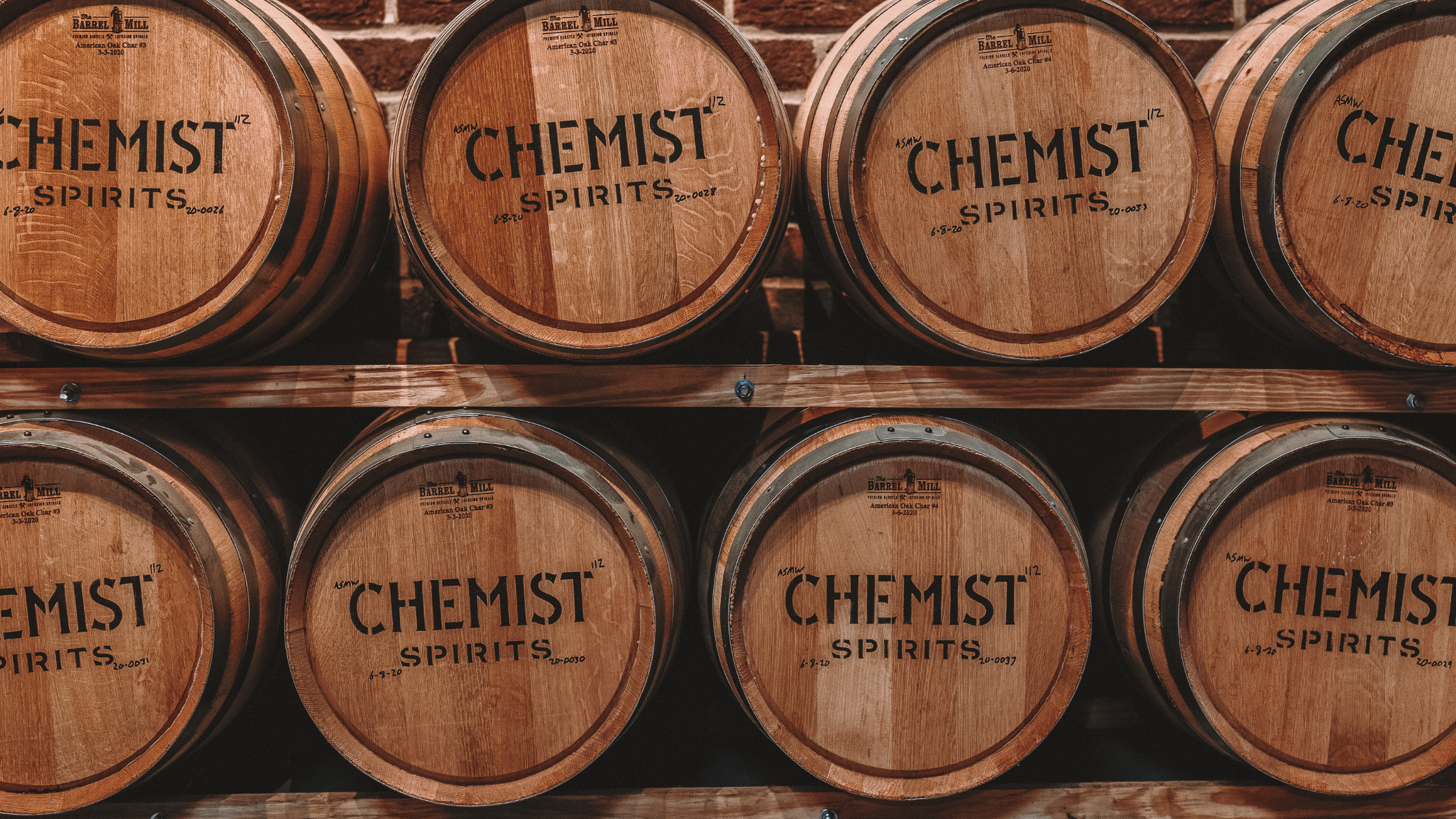
Whiskey is a grain-based neutral spirit that is aged in wood. We at Chemist Spirits love whiskey in all its forms. So, in this article, we want to uncover some of the basics surrounding this spirit: what whiskey is and how it’s made.
What is Whiskey?
At its base, whiskey is a grain-based non-neutral spirit aged in wood. The grain can be barley, wheat, quinoa, or any other grain, and many types of whiskeys are defined by the specific grain and percentage of that grain used in the mash.
By non-neutral, we simply mean that it has a distinct flavor profile, and takes on the aroma and characteristics of its base ingredients. A neutral spirit is typically used as a base for more complex spirits like gin since it doesn’t have a flavor, aroma, or color.
We use a neutral spirit made from a base of wheat for our American Gin while our American Single Malt Whiskey is distilled from a mash bill of three different barley malts.
After distillation, the base spirit must be stored in oak barrels; for some whiskeys, like Bourbon, the distilled spirits can technically just pass over wood and be categorized as that type of whiskey, but contact with wood is necessary for it to be considered whiskey.
How is Whiskey Made and What is Whiskey Made of
Whiskey (or whisky) begins as grains that are made into a mash, fermented, distilled, and then aged in wood barrels. The initial process of mashing and distilling can be done in a week or so, depending on the length of fermentation while the aging process typically lasts years.
Step 1: It All Starts with the Grain
The very first step of the whiskey-making process focuses on the grain. Choosing your cereal grain is crucial for developing the flavors and aromas that will be inherent in your spirit. The typical grains used in the making of whiskey include:
Barley: Necessary for earthy, nutty flavors
Rye: Imparts a quality of spice and intensity
Corn: Imparts sweetness
Wheat: For a smoother profile
Whiskey is typically made from one or more of these grains with a varying combination of some or all. Different ratios of grains result in different flavor profiles and lend itself to qualities particular to different brands of whiskey. Although those are the four most popular, whiskey can be made from any cereal grain, and some other grains that distilleries experiment with include:
Quinoa
Oats
Many distilleries, like ourselves, will use local grains to create spirits with personalities specific to the region.
Step 2: The Malting
Malt is a sprouted grain that develops the amylase necessary for the fermentation process. In this process, the grain is soaked to wake it up and allowed to germinate and sprout. The sprouting allows for the development of enzymes which are necessary for the fermentation process.
This growth is then halted and the flavors intensified by drying the grain, which can impart a lot of flavor.
Scotch gets its peaty flavor from the malted barley being dried over the smoke of burning peat. If a distillery doesn’t use a malted grain, they will typically introduce yeast to catalyze fermentation, but typically will use yeast in combination with the malted grain.
Step 3: The Mashing
A mash is the result of the grains being ground up, mixed with water, and then heated. This process breaks down the starches into sugars that will eventually be converted in alcohol from the enzymes produced by the malting process and/or the introduction of the yeast later on.
Step 4: Fermenting
After the introduction of the yeast, the mash is left to ferment, typically in stainless steel fermentation tanks. This process can take up to a week with specific whiskeys, like Japanese whiskeys, choosing the longer fermentation. The resulting liquid, called “distiller’s beer,” now has an alcohol content similar to beer.
Step 5: Distillation
The distiller’s beer is placed in some kind of still, be it pot, column, or hybrid typically, and the liquid is heated up. At lower temperatures more dangerous and unpleasant compounds are heated to their boiling point, evaporated, and condensed.
The initial products of fermentation, typically called the heads, are collected and either discarded or used for future distillations.
As the distiller’s beer continues to heat up, the more pleasant and coveted compounds, namely alcohol or ethanol, evaporate and condense. This is the hearts section of the distillation process and is what ends up in your bottle of whiskey.
The end of the distillation process results in the tails, which are also either discarded or used for future distillations.
Some whiskeys, like Irish whiskeys, are triple distilled to a higher alcohol content resulting also in a lighter spirit.
The White Dog
Prior to fermentation, the mash will have a dark color while after distillation, the resulting condensed liquid will be clear. This base liquor can be distilled multiple times and is typically referred to as a White Dog.
The White Dog can still be considered whiskey, but it may not be the most palatable thing to drink. The flavors can be sharp and harsh, which is where barrel aging comes in.
Step 6: Barrel Aging
What gives whiskeys their dark color is the barrel-aging process. This process may not have been a conscious decision in the history of whiskey making, and most likely was from the base liquor being transported in barrels.
Gins undertook the same transportation methods as they traveled on ships across the sea. Constant jostling and motion allowed the spirit to make repeated contact with the wood and resulted in a spirit that was more mellow and took on the characteristics and color of the wood. This has become a common practice for many spirits.
Distilleries like us intentionally “rest” our gins in barrels to make Barrel-Rested Gin and rest grain spirits in barrels to make whiskey. Different distilleries will experiment with different types of wood as well as different char levels to impart different flavors. Some whiskey companies will even reuse barrels originally used for port or beer to adopt those aromas and characteristics.
Different whiskey categories and labels require different lengths of aging, Scotch being the more stringent. Bourbon doesn’t require any minimum aging and can simply sit in a barrel for a day to be considered bourbon. Now, will that be a tasty bourbon? Probably not, and most distilleries will age their Bourbons for much longer.
We typically like to age our single malt for at least two years, although most of the time we will age it for 3 to 4 years. For many whiskeys like American single malt and bourbon, aging the spirit for at least two years gives it the label of “straight” as in straight American single malt or straight bourbon whiskey.
The specific ABV also affects the aging process, with a higher alcohol content taking out the tannins from the wood, while lower alcohol content allows for the catalyzation of sugars. We barrel at barrel strength instead of proofing down before aging.
Conclusion
The world of whiskey is vast and complex, and although this article only skirted the surface, hopefully it gave you a deeper understanding, and maybe, a deeper desire to sip on something dark.
Want to continue your whiskey education? One of the best ways to better understand the wide world of whiskey is to taste them! Order from Chemist Spirits to taste our award-winning American Single Malt Whiskey.
Or stop by the tasting room or the Antidote Cocktail Lounge to taste all of our single malts so you can answer the question: what is whiskey?
Frequently Asked Questions about Whiskey
What is the Difference Between Scotch and Irish Whiskey?
Scotch is typically (but always) peated while Irish whiskey is not. This makes Scotch smokey. Irish whiskey is triple distilled while Scotch is typically double distilled. Scotch whisky must be made in Scotland to be considered Scotch, and Irish whiskey must be made in Ireland to be called Irish whiskey.
Whiskey vs. Whisky?
Both are the same but whiskey is the common spelling in the U.S. and Ireland while whisky is common in Scotland, Japan, and Canada.
What is Bourbon Whiskey?
Bourbon whiskey is whiskey with a mash bill of at least 51% corn. The rest of the mash bill can be made of barley, wheat, and/or rye.
What is Rye Whiskey?
Rye whiskey is a whiskey that is made of at least 51% rye, the remaining of which can be made of barley, wheat, and/or corn.
References:
How Irish whiskey is made. (2020, March 17). https://www.diffordsguide.com/g/1144/irish-whiskey-uisce-beatha-eireannach/production
Wondrich, D., & Rothbaum, N. (2021). The Oxford companion to spirits and cocktails. Oxford University Press.
